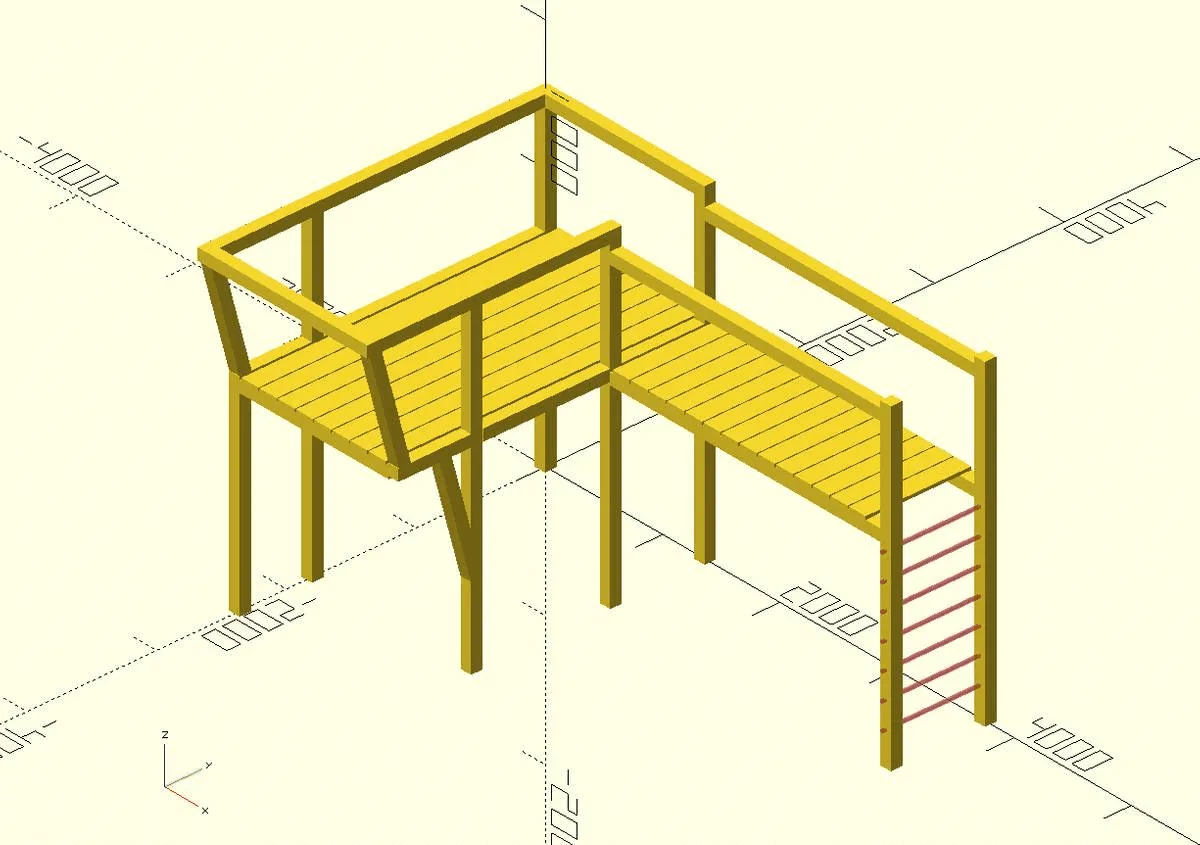
This is the design for a play tower in Bangkirai wood that I had actually wanted to put up in our garden. Sadly our building authority thwarted the plan with conditions such as registering a land charge with the neighbour and commissioning surveyors — but perhaps someone has more space on their plot and doesn't have to build close to the boundary. (And yes, my granddaughter got a nice "structure" as a replacement, too ;) )
Hardly anyone will rebuild this tower one-to-one — what's more interesting is how a design like this comes about. OpenSCAD isn't just for small printed parts; it's just as good for planning a whole woodworking project to the millimetre beforehand.
The pattern: many identical parts with for
A tower is made of dozens of planks — you don't write them out one by one, you generate them in a loop:
// planks towards the wall

for (a =[0:13]) {
    translate([1360+45+20+a*(145+10),45,1500+90])
    dieleY(816);
}
a takes on the values 0, 1 up to 13 in turn; with each pass the next 81.6 cm plank moves on by 145+10 mm — plank width plus gap. Three lines become 14 neatly aligned boards. This exact pattern — placing your own module (dieleY) inside a for loop — carries every repeating project: a fence, a railing, a slatted base, a shelf. Once it clicks, you can plan your own woodworking project with it.